
Facial Muscles: Anatomy and Its Significance in Botox Treatments
Facial muscles are facial expression muscles that attach directly to the skin and enable facial expressions such as raising the eyebrows, furrowing the brow, and squinting. Many cosmetic Botox treatments target these muscles because their repeated contraction causes facial lines and wrinkles.
Abstract
The facial muscles allow for expressions such as raising the eyebrows, furrowing the brow, and squinting. Many Botox treatments target these specific muscles. Botox, or botulinum toxin, acts at the neuromuscular junction to temporarily reduce muscle contraction.
When a muscle relaxes, the skin overlying it does not wrinkle. This allows the lines to smooth out. Botox treatments are used, for example, to treat forehead wrinkles, frown lines, and lines around the eyes. Understanding the anatomy of the facial muscles helps explain why certain wrinkles form and how Botox treatments affect them.
Facial expression muscles
The facial expression muscles are small but active muscles that attach directly to the skin. When these muscles contract, the skin moves with them, creating facial expressions. Over time, repeated muscle contractions lead to the formation of permanent lines and wrinkles.
Botox treatments are most often administered to the facial muscles. Botox temporarily reduces the activity of the treated muscle. As the muscle relaxes, the skin overlying it does not wrinkle as it normally would. As a result, the lines caused by muscle activity are smoothed out.

Frontalis – the frontal muscle
The frontalis is a muscle located in the forehead region that raises the eyebrows and forms horizontal wrinkles on the forehead. When this muscle is repeatedly activated, permanent lines may form on the forehead.
In Botox treatment, injections are administered into the frontalis muscle according to an individualized treatment plan.
Read more:
Botox for the forehead

Corrugator supercilii – Glabellar lines
The corrugator muscles pull the eyebrows together, forming vertical wrinkles between them.
Botox treatment is targeted at the corrugator muscles.
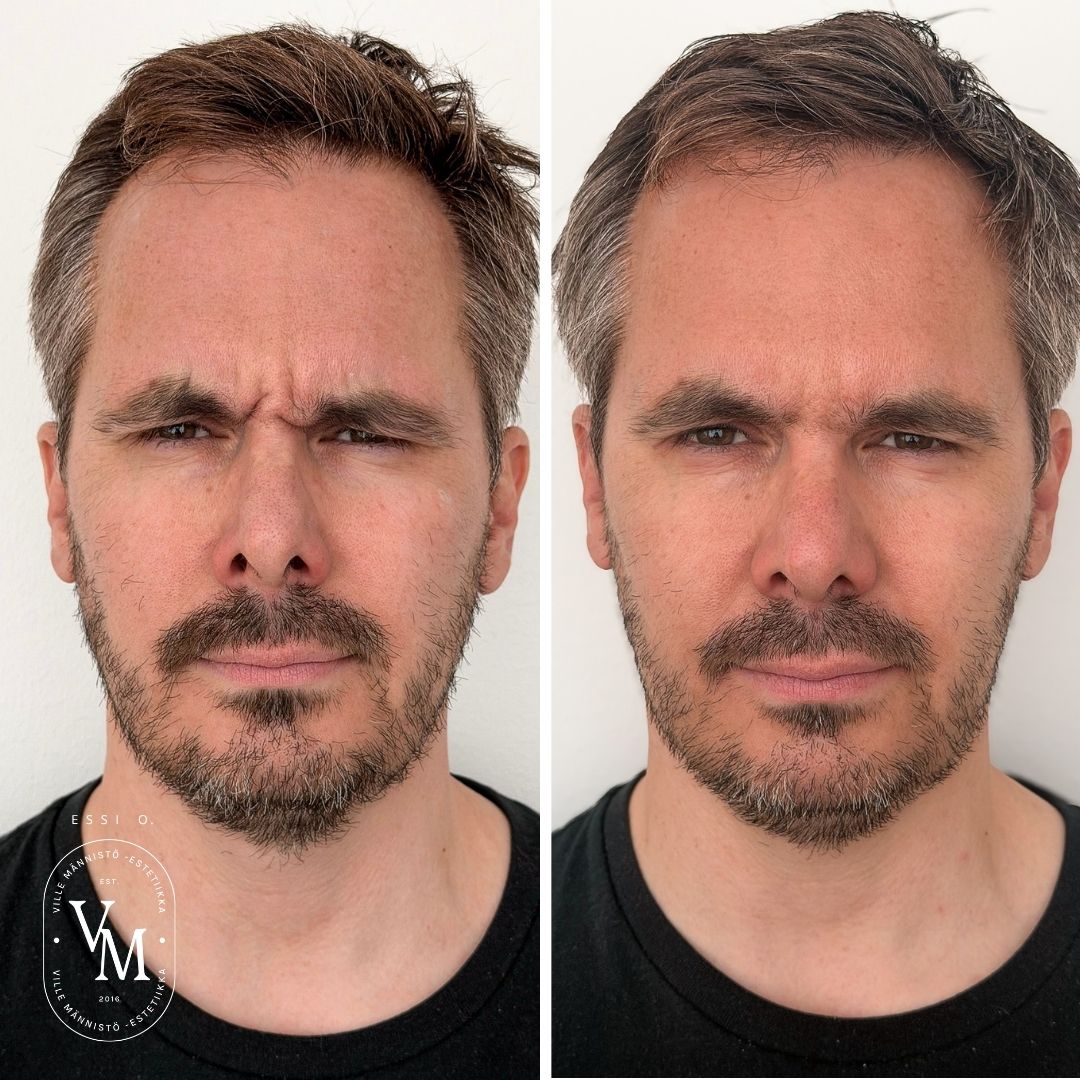
Glabellar lines It is caused by the contraction of the corrugator and procerus muscles between the eyebrows.
Orbicularis oculi – the muscle surrounding the eye
The orbicularis oculi muscle surrounds the eye and helps close and squint the eyes.

Masseter – masticatory muscle
The masseter muscle raises the lower jaw. It is a powerful closing muscle and is involved in both anterior and posterior occlusion. Botulinum toxin injections into the masseter and temporalis muscles often significantly reduce teeth grinding.
Read more: Botox for bruxism
How does Botox affect muscles?

