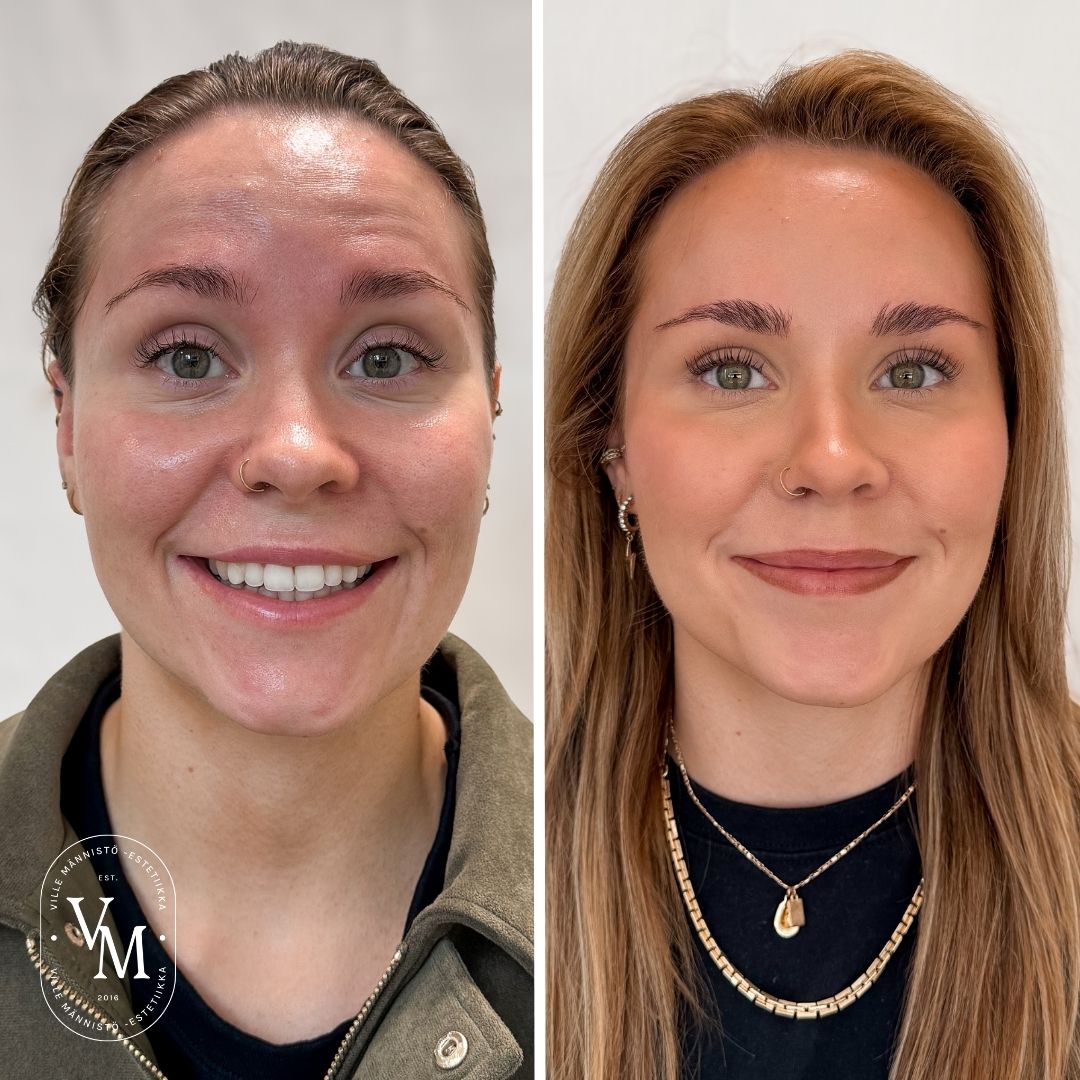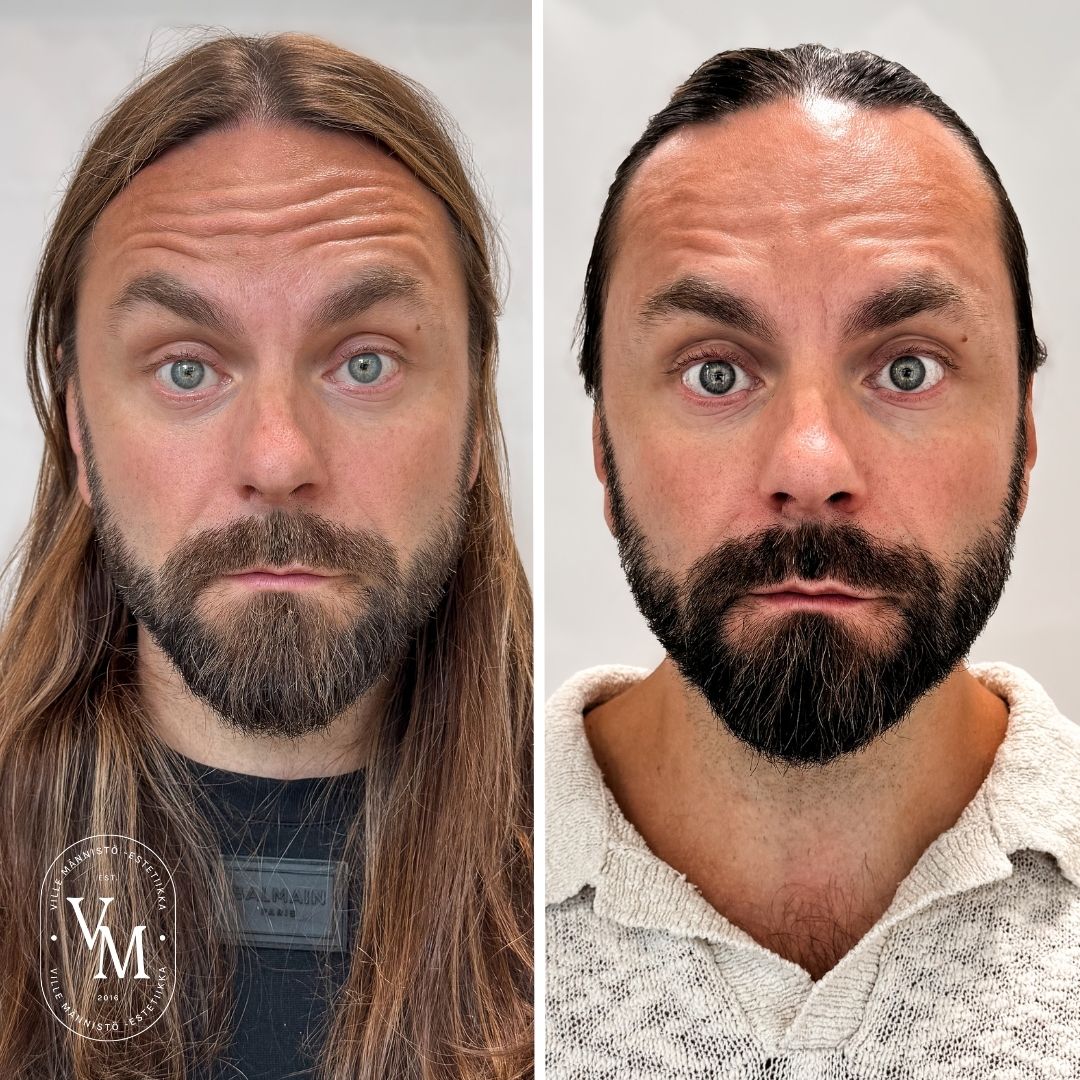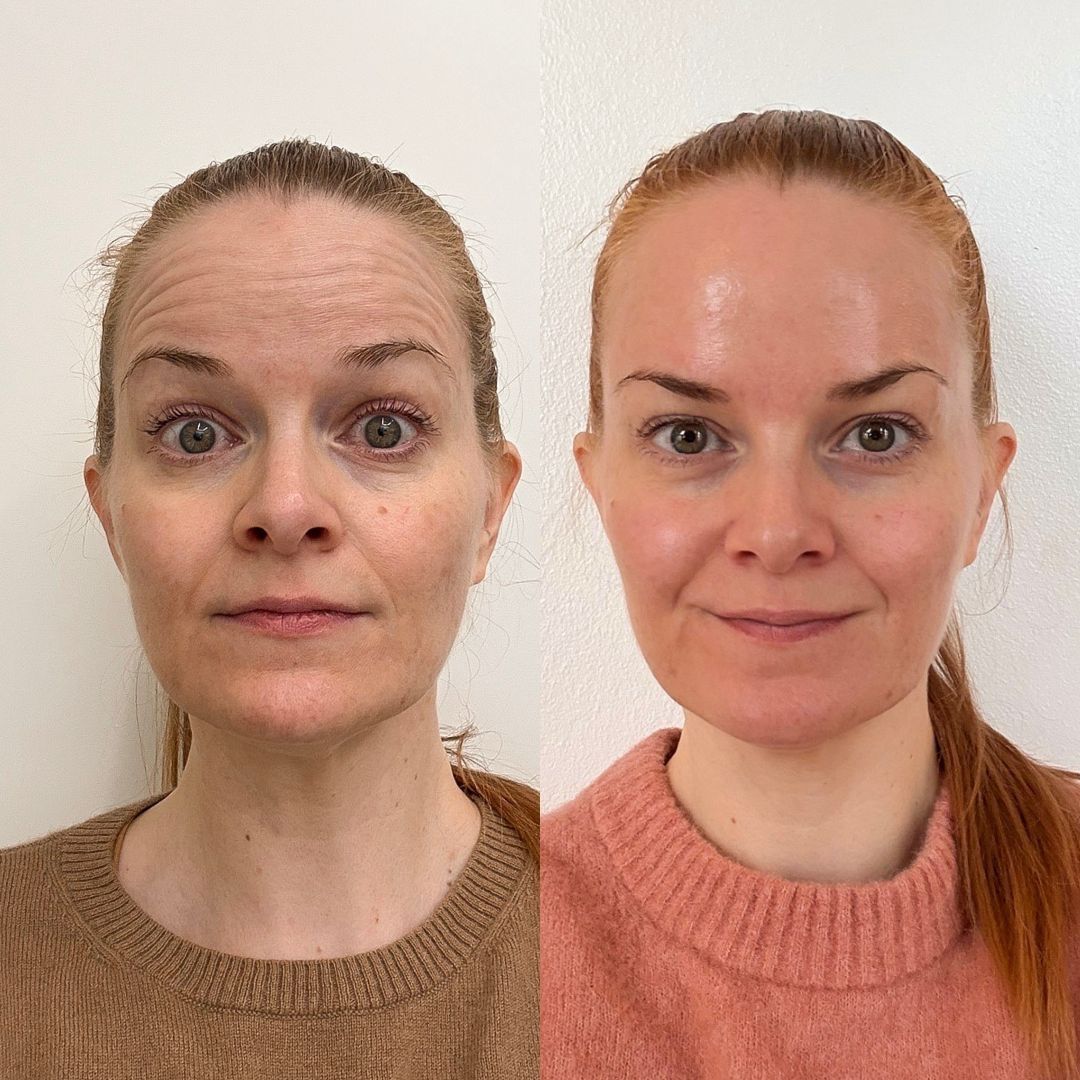
Botox Brow Lift – Benefits, Risks, and Cost
- Lifting the corners of the mouth is based on altering the balance between the muscles
- The effect is usually on the order of a few millimeters
- The results typically last 3–6 months
- The response to treatment varies from person to person
- Price: €270–450

How does Botox work to lift the corners of the mouth?
Botox brow lift
Ville explains why eyebrow lifts work best
with what’s known as the “three-area Botox treatment.”
Lifting the corners of the mouth involves working the following muscles:
- Corrugator supercilii – pulls the eyebrows downward and inward
- Procerus – pulls the corners of the mouth downward at the base of the nose
- Frontalis – lifts the corners upward

How much can the corners of the mouth be lifted with Botox?
Lifting the corners of the mouth with Botox usually results in a subtle change. The change is measured in millimeters.
Botox treatment does not lift the skin mechanically but alters the balance between the muscles. For this reason, the effect depends on how strongly the muscles that pull the eyebrows downward are working in relation to the forehead muscle that pulls them upward. In some cases, the corners of the mouth lift noticeably, but in others, the change is quite modest. The final result is typically visible within two weeks of treatment.
- A typical rise is in the range of a few millimeters
- The effect is often more of a softening of the expression than a distinct “lift”
- The response to treatment varies from person to person depending on facial anatomy
- It is best to view your first Botox treatment to lift the corners of the mouth as a "trial treatment," since it is difficult to predict how well you will respond to the treatment
- Significant tissue sagging does not improve with botulinum toxin treatment
In all cases, the change observed is not due to a lifting of the corners of the mouth, but rather to the opening up of the upper eyelid area. This can create the impression of a lighter, more relaxed expression without any significant change in the height of the corners of the mouth.


Botulinum toxin treatment in the eyebrow area does not always produce the same visual result. In some cases, the eyebrows rise slightly, while in others the change is primarily visible as a widening of the upper eyelid area without a significant change in the height of the eyebrows. This is due to individual differences in muscle balance and the function of the frontalis muscle, which raises the brow.
Similarly, in situations where the function of the frontalis muscle is weakened too much, the corners of the mouth may also droop. Consequently, the final result depends above all on how the Botox treatment is tailored to the individual’s facial anatomy.
Can Botox cause your eyebrows to droop?
It is possible for the corners of the mouth to droop or sag after Botox treatment. However, this drooping or sagging is always related to the technique used, not the medication itself.
How can corner collapse be prevented?
Botulinum toxin weakens muscle function at the neuromuscular junction. If the frontalis muscle is weakened too much in a situation where it is already maintaining the position of the eyebrows, the eyebrows may droop. This is particularly noticeable in people with a low forehead and already quite deep forehead wrinkles. In such cases, the forehead muscle acts compensatorily, and excessive relaxation of the muscle can lead to an undesirable outcome.
- The drooping of the corners of the mouth is associated with excessive weakening of the forehead muscle
- The risk is higher on a low forehead with fairly deep lines and excess skin
- Proper injection technique maintains and improves muscle balance
- Any sagging is always temporary

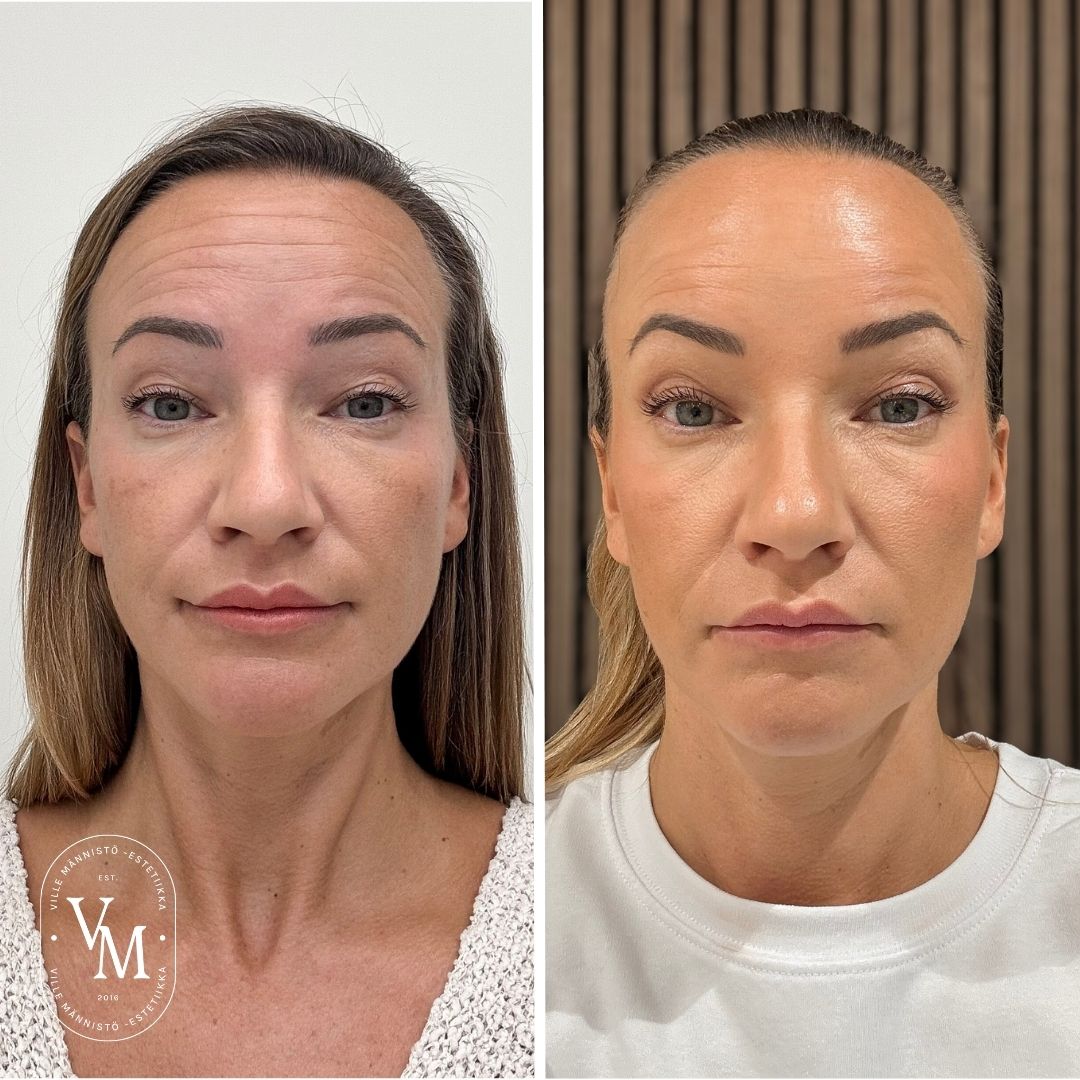
Lifting the eyebrows requires the right dosage, especially if the forehead is low or the lines are deep. Treatment often begins with a lower-than-normal dosage to prevent the eyebrows from drooping. In such cases, the forehead lines will not be completely smoothed out until after the second or third botulinum toxin treatment.
Who is a good candidate for Botox brow lifts?
A Botox brow lift is best suited for situations where the position of the eyebrows is primarily determined by muscle activity.
The effect of Botox treatment is based on altering muscle balance, so the treatment response is best when the muscles that pull the eyebrows downward are active and the skin is still relatively elastic. In such cases, relaxing the muscles can lead to a slight lifting of the eyebrows and a more open gaze. In contrast, in situations where the drooping of the eyebrows is primarily due to sagging of the skin and tissues, the effect is often minimal.
- The best response is seen when there is strong muscle activity in the muscles that pull the corners downward
- Good skin elasticity contributes to the final result
- In young and relatively young patients, the effect is often more pronounced than in older patients
- Significant tissue atrophy impairs the response to treatment
The assessment of a patient’s suitability for treatment is based on the overall anatomy and muscle function of the face. There are significant individual differences, and the final result cannot be predicted with complete accuracy in advance.
How long do the results (Botox to lift the corners of the mouth) last?
The effect of Botox on lifting the corners of the mouth is temporary. The results usually last a few months.
Botulinum toxin blocks the transmission of nerve impulses to the muscle, but the neuromuscular junction returns to its original state over time. As a result of this recovery, muscle activity also gradually returns to normal. Thus, the effect of the treatment gradually diminishes. As the effect of Botox wears off, the position of the eyebrows returns to its original state. The duration of the effect varies from person to person and depends, among other things, on muscle activity and the dose used.
- The effects usually begin within 3 to 7 days
- The full effect will be seen in about two weeks
- The duration is typically 3–6 months
- Muscle function gradually returns after treatment
In some patients, the duration of the effect may increase with repeated treatments, but there is individual variation in this regard, and the phenomenon is not fully understood.
Frequently Asked Questions About Botox Brow Lift
How much does a Botox brow lift cost?
This depends on individual anatomy.
- In very rare cases, a brow lift can be achieved with a single-area Botox treatment, in which case the price is 270 euros.
- In most cases, a balanced result is achieved by treating two or three areas, in which case the price is 360–450 euros.
- Botox treatment in one or two areas can slightly lift part of the eyebrows, but the result may look a little unnatural.
- Generally speaking, the best—and, surprisingly, also the most natural—results are achieved by treating all three areas of the upper face: the forehead, the glabellar lines, and the crow’s feet at the corners of the eyes.
Can Botox really lift the eyebrows?
Botox can slightly lift the eyebrows by altering the balance of facial muscles. This is not a matter of actually lifting the tissue, but rather of weakening the effect of the muscles that pull the eyebrows downward and enhancing the effect of the forehead muscle.
What kind of results can you expect from a Botox brow lift?
Lifting the corners of the mouth with Botox provides clear—albeit moderate—benefits for the majority of clients. For a small number, the results are disappointingly modest.
Everyone’s face is different, which is why everyone’s experience is unique. The first botulinum toxin treatment reveals each person’s individual response to the treatment. That is why it’s best to view the first treatment as a sort of trial.
How much do the corners of the mouth lift with Botox?
The typical change is in the range of a few millimeters. Often, the effect is more noticeable as a widening of the eyes than as a distinct lifting of the eyebrows.
Can Botox cause your eyebrows to droop?
Yes, if the function of the forehead muscle is weakened too much, especially in the case of a low forehead. Properly targeted treatment maintains muscle balance and significantly reduces this risk.
Who benefits most from Botox brow lifts?
The best results are achieved when the position of the corners depends mainly on muscle activity rather than tissue sagging. Good skin elasticity and active facial muscles contribute to the final result.
How long do the results of a Botox brow lift last?
The effect usually lasts 3–6 months. Muscle function gradually returns as the neuromuscular junction heals, after which the position of the eyebrows returns to normal.
Summary: What does Botox actually do to lift the corners of the mouth?
Lifting the eyebrows with Botox is not a procedure that actually lifts the tissue; rather, it works by altering the balance of facial muscles. When the activity of the muscles that pull the eyebrows downward is reduced, the effect of the forehead muscle becomes more pronounced, and the position of the eyebrows may rise slightly.
In practice, however, the end result is not the same for everyone. In some cases, the eyebrows are lifted, while in others the main change is a more open gaze without any significant change in the height of the eyebrows. Conversely, improperly targeted treatment can lead to sagging eyebrows if the function of the forehead muscle is weakened too much.
The final result depends on individual anatomy, muscle activity, and how the treatment is administered. For this reason, raising the eyebrows with Botox is a phenomenon that is clinically predictable but not entirely standardized.
The key point is to understand that the outcome is not always the same, but rather that there are several possible responses within the framework of the same biological mechanism.
Author
Ville Männistö is an oral and maxillofacial surgeon who specializes in aesthetic botulinum toxin treatments and disorders of the masticatory muscles.
Her clinical work focuses on understanding facial muscle function, anatomy, and the mechanisms of action of botulinum toxin in both aesthetic and medical treatments.
He is also a member of a research group studying dysfunction of the masticatory muscles and the effects of botulinum toxin treatments. The study has been published in an international peer-reviewed scientific journal.
The study is available in the PubMed database:
Temporomandibular disorders and masticatory muscle dysfunction – Journal of Craniofacial Surgery
If you’d like to learn more about how Botox treatments are performed in practice and what conditions can be treated with botulinum toxin, you might find Ville’s comprehensive guide to Botox treatments helpful.