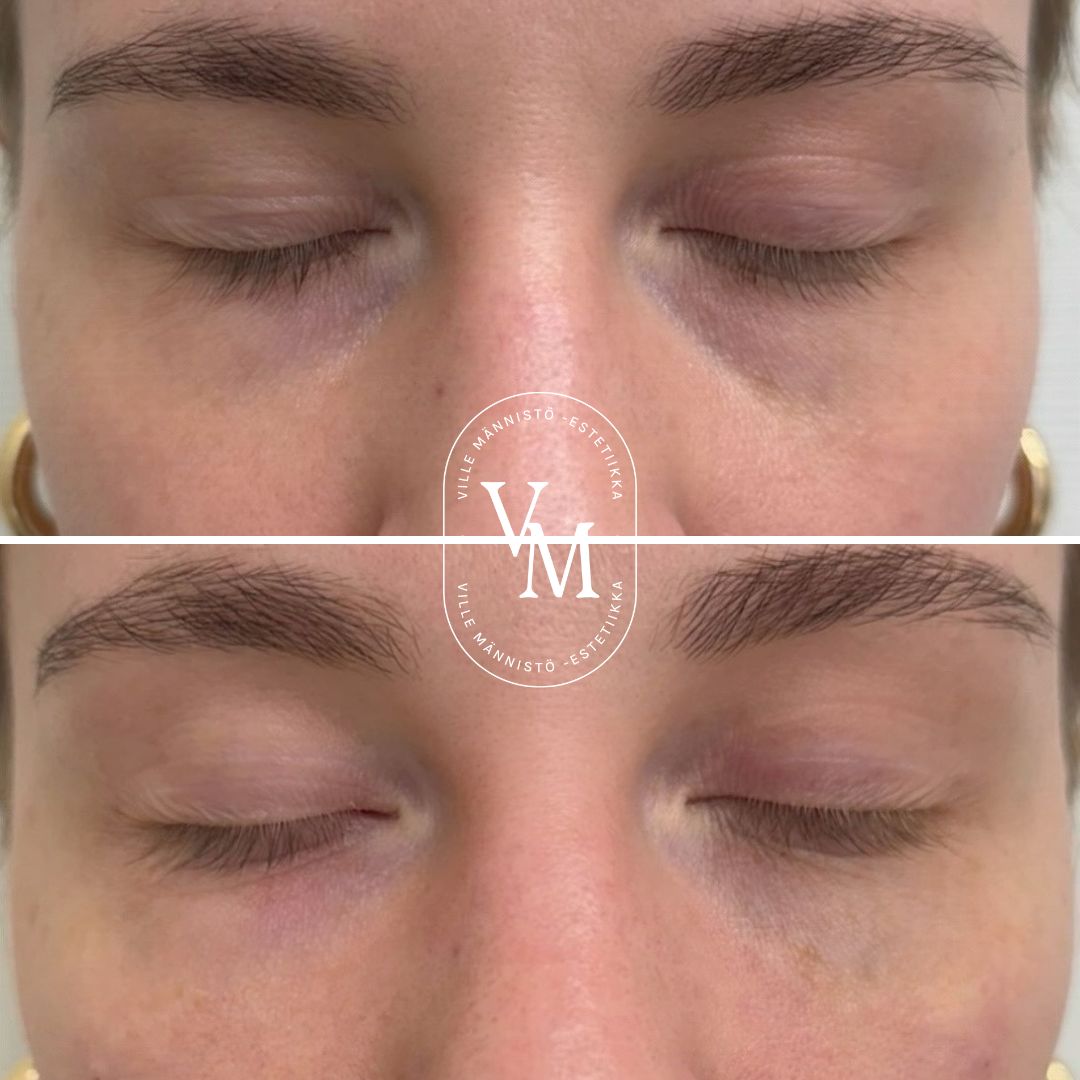
Filler injections for tear troughs are an excellent but demanding treatment.
It is not the only option for treating under-eye skin problems—nor is it always the best or most effective one.
This article explores who is a good candidate for tear trough fillers and in what situations it might be better to choose a different cosmetic treatment.
This article is based on an interview with Ville Männistö at surgeon , as well as current research evidence.
Do the areas under your eyes look tired? The cause isn't always the tear duct
You sleep for eight hours, enjoy your morning coffee in peace, and feel refreshed. Then you glance in the mirror. Staring back at you is someone who looks as if they hadn't slept a wink.
Does that sound familiar?
A tired-looking gaze does not always indicate fatigue. The appearance of the under-eye area is influenced by skin thickness, the condition of the subcutaneous soft tissues, and the facial bone structure.
As we age, a lot happens to the skin under the eyes. Sometimes it’s the tear trough, and sometimes it’s something else. This is precisely why the skin under the eyes is one of the most fascinating—and challenging—areas of treatment in aesthetic medicine.
Just five years ago, tear trough fillers were practically the only viable treatment for dark, creased under-eye areas. Today, a clinician’s toolkit includes many other options as well.
Options include, for example
filler treatments
Profhilo treatments
polynucleotides and mesotherapy
microneedling
laser treatments
The wide variety of options is good news; one single treatment method does not suit everyone.
The Profhilo treatment is also excellent for improving the condition and appearance of the skin under the eyes. The two-session Profhilo treatment series was performed by nurse Katri Martin.
During the consultation, the most important question isn’t whether the under-eye area needs filler. It’s more important to determine why the under-eye area looks the way it does. Once the cause is identified, the best treatment can be determined.
– Ville Männistö
Filling in the tear troughs naturally refreshes your appearance.
A successful treatment enhances the area under the eyes without altering your face’s unique expression.
You don't have to take care of everything
Aging isn't a disease, and there's nothing wrong with dark circles under the eyes. Some people like their features just the way they are. Others are fond of non-invasive cosmetic treatments.
Both approaches are equally valid.
Cosmetic treatment is not an obligation but an opportunity.
If you decide to explore your options, the first step isn't getting an injection—it's a careful assessment of what exactly is causing the appearance of the area under your eyes.
What Is the Lacrimal Duct? A Look at the Anatomy of the Area Under the Eyes
The tear trough is a groove that runs from the inner corner of the eye toward the cheek. It is part of the natural anatomy of the face. Everyone has tear troughs. In some people, they are clearly visible; in others, they are not.
Are you looking for a beauty sleep?
When you're tired, your tear troughs often appear deeper than usual. If your tear troughs disappear after a good night's sleep, relaxation, and a vacation, this cosmetic issue can be resolved with a simple home remedy: getting a good night's sleep.
Your facial expression changes as you age
Over the decades, the area under the eyes changes:
A young person's tear ducts are often hard to spot.
Over the decades, the fullness and radiance of the under-eye area diminish.
The fatty tissue beneath aging skin shrinks and shifts toward the middle and lower parts of the face.
Consequences of the changes:
The skin under the eyes becomes thinner, drier, and more wrinkled.
Tear tracks begin to appear.
The area under my eyes looks more hollow, darker, and more lined than before.
Tear ducts encoded in genes
The answer may also lie in your family history. Dark circles under the eyes, pitted skin, and tear troughs running from the inner corners of the eyes toward the cheeks can be part of your genetic makeup, just like eye color.
So not all dark spots, wrinkles, and sagging are caused by sleepless nights or aging. Aesthetic problems are often encoded in a person’s genes.
A Skewed List of Other Explanatory Reasons
You can't blame visible tear troughs any more on your genes than you can on fatigue or your age.
Allergies and prolonged sinus symptoms can accentuate the fine lines that start at the inner corners of the eyes.
Lifestyle factors also play a role. Prolonged lack of sleep, stress, and general strain do not actually cause tear troughs, but poor lifestyle habits can make them more visible than before.
"If you notice rapid external changes in the skin under your eyes for no apparent reason, it's a good idea to see your primary care physician," Ville reminds us.
For Alina, a very subtle tear trough filler injection was enough.
Ville took the “after” photo immediately following the procedure.
“Filler can be added if necessary, but removing it is a bit more complicated,” Ville explains.
Make the right choice: tear trough fillers aren't for everyone
Tear trough filling is one of the most rewarding—but also one of the most demanding—procedures in aesthetic medicine. Patient selection is crucial.
In the right patient, a small amount of filler can make the eyes look noticeably fresher. On the other hand, if the problem isn’t caused by natural tear troughs, filler treatment can actually make under-eye issues worse.
Successful treatment begins with a thorough consultation and a clinical examination of the skin under the eyes.
The perfect candidate for filling tear troughs
Did you think that the deeper the tear troughs are, the more beneficial filler treatment would be?
In reality, the opposite may actually be true. The best results are achieved when the problem under the eyes is well-defined and the tear duct issue is not accompanied by eye bags, swelling, or sagging skin.
Tear trough filler might be right for you if you have
a clearly visible but fairly narrow tear duct
skin under the eyes that is in good condition and firm
only a few or no under-eye bags at all
a little puffiness under the eyes
The goal is a natural and subtle result
When is filling the tear ducts NOT the best solution?
Tear trough fillers are not a cure-all for every problem in the under-eye area. If the underlying cause of the problem is something other than the tear trough itself, the results of filler treatment may be modest. In the worst-case scenario, filler treatment can even accentuate aesthetic issues in the under-eye area. The most important aesthetic work is actually done during the consultation, before the very first injection.
Filling the tear ducts is not the best option if
I have visible under-eye bags
The skin under the eyes has become saggy
There is excess skin or fat in the area
The area under the eyes tends to swell easily, for example in the morning or when suffering from allergies
The biggest problem is darkening of the skin without any indentation or an actual tear trough
It’s all about finding the right key. Sometimes, filling the tear ducts is like using the wrong key. That’s why you shouldn’t force it into every lock. The wrong key won’t open the door. In the worst case, the wrong key will damage the entire lock cylinder.
When your cheeks need more care than your tear ducts
Sometimes it's worth looking a few centimeters lower—at the cheek.
The problem in the under-eye area isn't necessarily limited to the skin under the eyes. As a person ages, the fatty tissue in the cheeks also shrinks and shifts. And when the midface loses its support, the tear trough may also become more prominent than before.
Very often, the first step is a filler treatment to support the midface, rather than filling the tear troughs.
According to studies, facial contouring also affects the tear troughs. When the cheek regains its proper support, the boundary between the under-eye area and the cheek becomes smoother without the needle even coming close to the tear troughs.
– Ville Männistö
What if the skin under your eyes actually needs something completely different?
Filler is an excellent tool when used in the right situation. But just as a hammer isn’t the only tool you need for a renovation project, filling in tear troughs won’t solve all the challenges in the under-eye area.
Sometimes you need to improve the conditionof your skin. In such cases, you turn to treatments that activate the skin’s own rejuvenation mechanisms.
The new Profhilo protocol is suitable for treating problems in the skin around the eyes. Profhilo’s honey-like, widely spreading hyaluronic acid smooths the under-eye area without making it look overly plump.
Microneedling, when performed as a series of treatments, also stimulates collagen and elastin synthesis in the skin.
Polynucleotideand mesotherapy treatments, administered via multiple injections, are suitable for treating nearly any problem in the under-eye area. Sometimes they also provide significant relief for the tear trough.
If you have a lot of excess skin or fat on your lower eyelids, it's best to consult a plastic surgeon.
The best treatment results are achieved when the right procedure is chosen. There are situations in which it is best to avoid using fillers altogether.
Filling the tear ducts worked out better than expected for this client.
Schedule a free consultation
Not all under-eye areas require tear trough fillers. Sometimes the best solution is a filler; sometimes it’s treatments that improve the skin’s condition and appearance. Sometimes no treatment is needed at all.
During your consultation, we'll work together to determine the exact cause of your aesthetic concern and identify the treatment that will achieve the most natural-looking results.
The consultation is free of charge and does not obligate you to anything.
What are customers’ experiences with tear trough fillers?
Most customers say the end result looks, above all, natural.
“Few people are looking for that ‘pillow face’ effect from the past,” Ville chuckles.
How are the tear ducts flushed?
It all startswith a conversation
Before we even bring out the syringe, we always determine the underlying causes of your under-eye concerns. First, we discuss your concerns; then we assess your facial proportions, skin characteristics, any under-eye bags, the support of your midface, and how light and shadow play out on your specific face.
It might be a good idea to take a few photos at this stage. A camera reveals details that are otherwise hard to notice.
If they’re already injecting filler five minutes after you arrive at the clinic, they’re rushing things. Tear trough filling is one of the most demanding procedures in aesthetic medicine. It shouldn’t be done on an assembly line.
– Ville Männistö
It takes about a quarter of an hour to inject
The planning and preparation phase takes almost as much time as the filler treatment itself.
The actual filling of the tear ducts generally proceeds as follows:
The area under the eyes is cleaned thoroughly
The filler is injected into a precisely selected area using a fine needle or cannula
The amount of filler used in the treatment is usually very small
Progress is monitored throughout the course of treatment
If necessary, the filler is gently shaped into place
The client receives a link to the online home care instructions before leaving for home
Most patients describe the treatment as surprisingly painless. A slight pinch is to be expected, but there is generally no actual pain. In most cases, you can return directly from the clinic to work, lunch, or your other daily activities.
Of course, there may be some slight swelling in the treated area, and sometimes even bruising.
Less is more
Filling tear troughs is one of those treatments where patience really pays off. The under-eye area is anatomically delicate and the skin is thin. Even small amounts of filler can have a surprisingly significant effect on appearance. That’s why experienced aesthetic doctors prefer to aim for a result that’s slightly too subtle rather than one that’s too noticeable.
Studies and international treatment guidelines all emphasize the same idea: Small amounts of filler and a conservative approach make tear trough filling a safe procedure. A moderate approach to treatment also produces the most natural-looking results.
Good care is based on three principles:
the smallest possible amount of filler
Avoiding overfilling
I'd rather have two light treatments than one big one
Filling tear troughs isn't a matter of milliliters. The most natural-looking result is achieved when as little filler as possible is used, but applied exactly where it's needed. If necessary, the results can be touched up—say, six months later.
– Ville Männistö
A good outcome comes not from the boldest but from the most carefully considered injection. This is not just a matter of Ville’s personal opinion or clinical experience. Above all, it is a matter of the latest research evidence.
How long does it take for the tear ducts to fill up?
Filling the tear troughs is a quick procedure: the injection itself takes 15–20 minutes.
Most people are more interested in how long the results last than in how long the procedure takes. The results of tear trough fillers typically last for about a year.
There are significant individual differences. The latest scientific studies suggest that for some patients, the benefits of treatment may be clearly evident for even longer than a year.
Tears don't wait for the calendar
The internet and AI applications indicate that the results last 6–12 months.
This information is generally accurate. However, it is not the whole truth. Studies published in recent years have shown that a well-performed tear trough filler treatment can maintain its effects for significantly longer than a year.
A meta-analysis published in 2024 reported that the treatment’s effects lasted for at least 8–12 months in most patients. Even more interesting results were obtained in a retrospective study published in 2025, in which a significant proportion of patients still benefited from the treatment even after 18 months.
– Surgeon Ville Männistö
However, you shouldn’t make any promises based on this. The filler breaks down at a slightly different rate for everyone, and there’s no single correct figure for how long the results will last. Filling the tear troughs isn’t like a carton of milk where you can print an expiration date on the side. The result changes gradually along with your face.
Three Important Factors
Not all fillers behave the same way. The duration of the effects of tear trough fillers depends on both the treatment method used and individual characteristics.
The following factors, in particular, affect the duration of the final result:
Filler used. Hyaluronic acid products suitable for the under-eye area are selected for filling tear troughs. There are differences in the properties of these products.
Individual metabolism. In some people, hyaluronic acid breaks down in the body faster than usual; in others, it breaks down more slowly. Lifestyle factors can also affect how long the filler lasts.
Starting point. When the filler is injected into the right patient at the right spot, the results last a long time and look good throughout the entire degradation process.
Looking at the Other Side of the Coin: Risks and Side Effects of Lacrimal Duct Filling
According to studies, serious complications associated with tear trough fillers are rare. However, the under-eye area is anatomically challenging to treat, which is why the procedure is always performed by a medical professional who is very familiar with the anatomy of the area. The practitioner must be able to distinguish between common side effects, preventable risks, and rare complications.
Side Effects and How to Manage Them
Mild swelling, bruising, tenderness, and temporary redness are common side effects. Swelling and redness usually subside within a few days without any special treatment. It may take a week or two for any bruises to fade.
Risks and How to Avoid Them
Overfilling, irregularities, and the Tyndall effect* can usually be prevented through careful patient selection, proper injection technique, and moderate use of the filler.
Complications and Their Treatment
Serious complications, such as vascular occlusion, are extremely rare, but they require immediate treatment with hyaluronidase. Professionals who perform dermal filler treatments must also be prepared for extremely rare complications.
* In the Tyndall effect, the filler begins to show through the thin skin under the eyes as a bluish shadow. This is usually caused by the filler being injected too close to the surface.
Get the most out of your tear duct fillers
Filling tear troughs is an excellent treatment on its own, but sometimes the best results are achieved when combined with another cosmetic procedure. Let’s dive into the world of solutions.
Botox Opens Up Your Eyes
Botox does not fill in tear troughs or replace dermal filler treatments. However, it can complement the final result surprisingly effectively. As crow’s feet are smoothed out, the eyes open up and the eyebrows lift slightly, making the eyes appear more open and rested than before. Tear trough fillers and Botox are, in fact, a delightful combination: one opens up and smooths the outer corners of the eyes, while the other corrects minor imperfections in the skin under the eyes.
Profhilo strengthens the skin from within
Fillers and Profhilo serve different purposes. While tear trough fillers restore lost support to the under-eye area, Profhilo focuses on firming the skin and providing deep hydration. A Profhilo treatment for the midface is an exceptionally effective treatment on its own, but it becomes even more effective when combined with tear trough fillers.
The cheekbones support the under-eye area
Sometimes the best results come about in an unexpected order. First, support is restored to the cheekbones; only then is it determined whether the tear troughs still need filler.
Scientific studies have shown that dermal filler treatments that support the midface often also smooth out the tear troughs. Filling the cheeks and very subtly filling the tear troughs is a classic, safe option when the goal is a change that is as natural as possible yet still very noticeable.
Cost of Tear Trough Filler
Filling the tear ducts costs 450 €.
The treatment is performed using Juvéderm, a hyaluronic acid product that contains the anesthetic lidocaine. If you are allergic to lidocaine, the Aliax filler will be used—at the same price of 450 euros.
You can pay for your treatment at the clinic in cash, by debit or credit card, or via contactless payment.
You can also make payments through our online store, where invoice and installment payment options are available.
Frequently Asked Questions About Tear Duct Filling
Do the tear ducts ever get blocked?
Most people say the treatment feels like nothing more than a slight pinch. The Juvéderm filler used contains lidocaine, which numbs the area and makes the treatment more comfortable.
How much filler is needed?
Tear trough fillers are typically administered in very moderate amounts. A natural-looking result is usually achieved with a smaller rather than a larger amount. The maximum amount is almost without exception one milliliter (0.5 ml per side).
When will the results be visible?
The change is visible immediately after the treatment, but the final result is not assessed until 2–4 weeks later, once the filler has settled into the tissue and any swelling has subsided.
How long do the results of tear trough filler last?
The results usually last for about 8–12 months. In studies, the effects have lasted for up to 18 months in some patients.
Can tear duct filling be reversed?
Yes. If necessary, hyaluronic acid fillers can be dissolved using the enzyme hyaluronidase.
What is the Tyndall effect?
In the Tyndall effect, the filler appears bluish or grayish when viewed through the thin skin under the eyes. This is not a dangerous complication, and the effect can usually be corrected by breaking down the filler.
Can filling the tear ducts make under-eye bags worse?
Oh. If the under-eye bags are pronounced, fillers aren't the best treatment option. A thorough evaluation before treatment will help you choose the right solution.
Is tear trough filler suitable for everyone?
No. Sometimes, a better alternative to tear trough filler is, for example, Profhilo treatment, polynucleotides, microneedling, laser treatment, or lower eyelid surgery. The most appropriate treatment is always selected on an individual basis.
Can I go to work after treatment?
Yes. Most people return to their normal daily routine immediately after treatment. However, there may be some mild swelling around the eyes during the first few days. If bruising occurs, it may take a week or two for the bruises to fade.
At what age is it appropriate to have the tear ducts filled?
Age is not a determining factor in the need for treatment. Some people seek treatment at a young age due to hereditary tear troughs, while for others, the area under the eyes gradually changes with age.
Can tear trough fillers be combined with other cosmetic procedures?
Yes. Tear trough fillers are often combined with treatments such as Botox, Profhilo, cheek filler treatments, or laser treatments. The treatment plan is always tailored to each individual.
Sources
Urdiales-Gálvez, F., and Farollch-Prats, L. “ ”
“Management of Tear Troughs with Hyaluronic Acid Fillers: A Dual Clinical-Practice Approach.”
Clinical, Cosmetic and Investigational Dermatology. 2021.
Trinh LN, Grond SE, Gupta A. Dermal Fillers for Tear Trough Rejuvenation: A Systematic Review.
Facial Plastic Surgery. 2022.
Liu X, Gao Y, Ma J, Li J. The Efficacy and Safety of Hyaluronic Acid Injection in Tear Trough Deformity: A Systematic Review and Meta-analysis.
Aesthetic Plastic Surgery. 2024.
Kato K, Kajiwara T, Furuyama N, Liew S. Filler-Based Correction of Tear Trough Depressions and Eye Bags in Japanese Patients: A Classification System and Treatment Algorithm.
Journal of Cosmetic Dermatology. 2023.
Liew S, Doreian S, Kunathathorn W, et al. Dark Circles Under the Lower Eyelid (Tear Trough and Lid-Cheek Junction): A Stepwise Assessment Framework.
Aesthetic Surgery Journal. 2024.
Jiang J, Wang X, Chen R, et al. Tear Trough Deformity: Different Types of Anatomy and Treatment Options.
Postępy Dermatologii i Alergologii. 2016.
Peng PH, Peng JH. Treating the Tear Trough: A New Classification System, a 6-Step Evaluation Procedure, Hyaluronic Acid Injection Algorithm, and Treatment Sequences.
Journal of Cosmetic Dermatology. 2018.
Puyana C, Montes JR. Long-Term Effects of Tear Trough Hyaluronic Acid Filler: A Retrospective Study.
Journal of Clinical and Aesthetic Dermatology. 2025.
Puyana C, Montes JR. Long-Term Effects of Tear Trough Hyaluronic Acid Filler: A Retrospective Study.
Journal of Clinical and Aesthetic Dermatology. 2025. (PMC full text)
Gorbea E, Kidwai S, Rosenberg J. Nonsurgical Tear Trough Volumization: A Systematic Review of Patient Satisfaction.
Aesthetic Surgery Journal. 2021.
Urdiales-Gálvez, F., and Farollch-Prats, L. “ ”
“Management of Tear Troughs with Hyaluronic Acid Fillers: A Dual Clinical-Practice Approach.”
Clinical, Cosmetic and Investigational Dermatology. 2021.
Toyoda Y, Honig S, Wilson A, Broach R, Percec I. Filler in the Tear Trough and Lid-Cheek Junction: A Cadaveric Evaluation of Filler Type and Manipulation Technique.
Aesthetic Surgery Journal Open Forum. 2023.