
Failed Filler Treatment—Help!
A failed dermal filler treatment can be corrected with hyaluronidase.
A dermal filler treatment is considered a failure when the client is dissatisfied with the final result, the filler has spread to the wrong area of the skin, or the substance has been injected incorrectly or into the wrong tissue layer. Hyaluronidase is an enzyme that breaks down hyaluronic acid-based fillers, thereby correcting an unaesthetic treatment outcome.
Price:
Consultation with Dr. Laura Juopperi: 0 €
1 hyaluronidase ampoule: 350 €
Any additional ampoules during the same appointment: 100 € per ampoule.
How is lip filler dissolved?
A botched dermal filler treatment is corrected by injecting hyaluronidase directly into the filler. The filler begins to break down immediately, but the final result is assessed after about 2–4 weeks.
Often, a single treatment is sufficient, but sometimes the filling material must be removed in several stages.
Expert
Laura Juopperi, M.D.
Certified in aesthetic and medical botulinum toxin treatments, collagen stimulation treatments, and dissolving fillers.
When is filler treatment considered a failure?
A filler treatment has failed if the final result does not feel or look right, or if the filler has settled in the wrong place.
A failed filler treatment is almost always corrected with hyaluronidase, which breaks down the hyaluronic acid-based filler. If there is a large amount of filler or if it has spread over a wide area, removal may need to be performed more than once.
The goal of the treatment is to restore a natural appearance.
It’s important for customers to know that not all fillers break down just as easily. Restylane Kysse can often be removed with just one hyaluronidase treatment, but Belotero Volume, for example, almost always requires at least a couple of removal sessions.
– Dr. Laura Juopperi
When is it necessary to remove fillers?
There are many reasons why it might be necessary to remove fillers. Sometimes the filler has been injected too shallowly or in the wrong spot; other times, the final result just doesn't feel right.
Typically, fillers are removed from the lips, the tear trough area, the cheeks, the nose, the nasolabial folds, and the chin. Fillers can be removed from the lips under local anesthesia, which makes the procedure completely painless.
– Laura Juopperi
A failed filler treatment or a complication?
Correcting an aesthetically unsatisfactory filler treatment is not urgent and is not always necessary, since the filler breaks down in the tissue over time anyway.
Filler treatments can go wrong in many ways:
- The filler spreads to the wrong area, such as outside the lips
- The results of filler treatment look unnatural
- The filler causes delayed side effects
- The filler has been applied too shallowly
- A hyaluronic acid product that was too thick was used in the filler treatment
When correcting an aesthetically unsatisfactory filler treatment, hyaluronidase is injected as sparingly as possible and precisely targeted only at the filler.
Complications are rare but possible. They must be treated immediately with hyaluronidase.
The following complications are rare but possible:
- Ischemia, or impaired blood flow to tissues
- Tissue necrosis, or tissue death
- Tissue Embolism
- Loss of vision
- Stroke
In the event of complications, hyaluronidase is administered in large doses over a wide area.
Filler treatments are generally safe, but even the most experienced professionals must be prepared for complications.
Dr. Laura Juopperi
We must be prepared for complications
Being prepared for complications is part of the professional expertise of a clinician who performs dermal filler treatments. To prepare for rare complications, the clinician maintains a hyaluronidase on-call protocol.
"Hyaluronidase activity" refers to the fact that
- A professional who performs filler treatments always has hyaluronidase within easy reach
- A professional who performs dermal filler treatments knows how to administer hyaluronidase treatment quickly and safely
Hyaluronidase is a prescription medication that belongs in every aesthetic medicine professional’s first-aid kit.
Please make sure to check with the practitioner performing your filler treatment that they have hyaluronidase on hand and know how to use it in case of an emergency.
How can a failed filler treatment be corrected?
In some cases, the filler can be removed with a needle. Removal with a needle is only possible if the capsule is clearly defined, superficial, and has well-defined borders. In such a situation, a small hole can be made in the capsule, through which the accumulated filler is squeezed out.
In most cases, however, hyaluronidase is required. Hyaluronidase is an enzyme that breaks down hyaluronic acid-based fillers in the tissue in a controlled manner.
A needle or the hyaluronidase enzyme?
- Needle removal: a superficial, well-defined capsule
- Hyaluronidase: broad, diffusely distributed areas of filler
Hyaluronidase breaks down only hyaluronic acid
Hyaluronidase works only on hyaluronic acid-based fillers. If the filler is, for example, calcium hydroxyapatite (Radiesse) or lactic acid (Sculptra), removal is significantly more challenging—and in some cases, even impossible, even with surgical methods.
The same applies to impurities and foreign substances found in cheap fillers, which, unfortunately, are present in many low-quality products. Hyaluronidase is unable to break down these substances.
Hyaluronidase is an enzyme that breaks down only hyaluronic acid.
How are fillers removed?
Before removing the filler, Laura carefully examines the area.
I examine, palpate, and assess the condition of the tissue. Sometimes it’s best to perform an allergy test on the client before the actual hyaluronidase treatment. I always perform the test on clients with multiple allergies, Laura explains.
During the procedure, hyaluronidase is injected directly into the filler. It begins breaking down the hyaluronic acid immediately. If a large amount of filler needs to be dissolved, or if it has spread over a wide area, additional treatment sessions may be necessary.
In many cases, a single treatment is enough. However, it's important to be prepared for the possibility that a second treatment may be needed 2 to 4 weeks later.
– Laura Juopperi
After filler dissolving
- Avoid wearing makeup on the day of your treatment.
- Sleep on your back and avoid putting pressure on your face.
- Avoid strenuous physical activity for 24 hours.
- Avoid alcohol for 24 hours.
- Avoid smoking for 24 hours.
- Do not touch or rub the treated area.
- Avoid hot showers, saunas, and sunbathing until the swelling goes down.
- You can apply a cold pack wrapped in cloth or paper to the affected area for 10 minutes at a time, 3–5 times a day.
- You can wear makeup the next day.
- If bruises appear in the area, you can cover them with makeup in the days following the treatment.
- We can perform another filler treatment on the same area no sooner than one month from now.
Download the Aftercare Instructions (fi & en)
Cost of Filler Dissolution
The cost of filler removal depends on how much Amphadase* is needed and how many treatment sessions are required. Often, one ampoule of Amphadase is sufficient, but if there is a large amount of filler or it has spread, we use two ampoules—or even more in some cases.
*) Amphadase is the brand name for hyaluronidase. Amphadase hyaluronidase is a prescription drug—and one that requires special authorization. Previously, the same compound was sold under the brand name Hylase.
at VM Aesthetics are as follows:
- 1 hyaluronidase ampoule €350
- 2 vials, €450
"I'll go over the prices with you before treatment so there won't be any unexpected additional costs. I want the entire treatment process to be completely transparent from start to finish," Laura says.
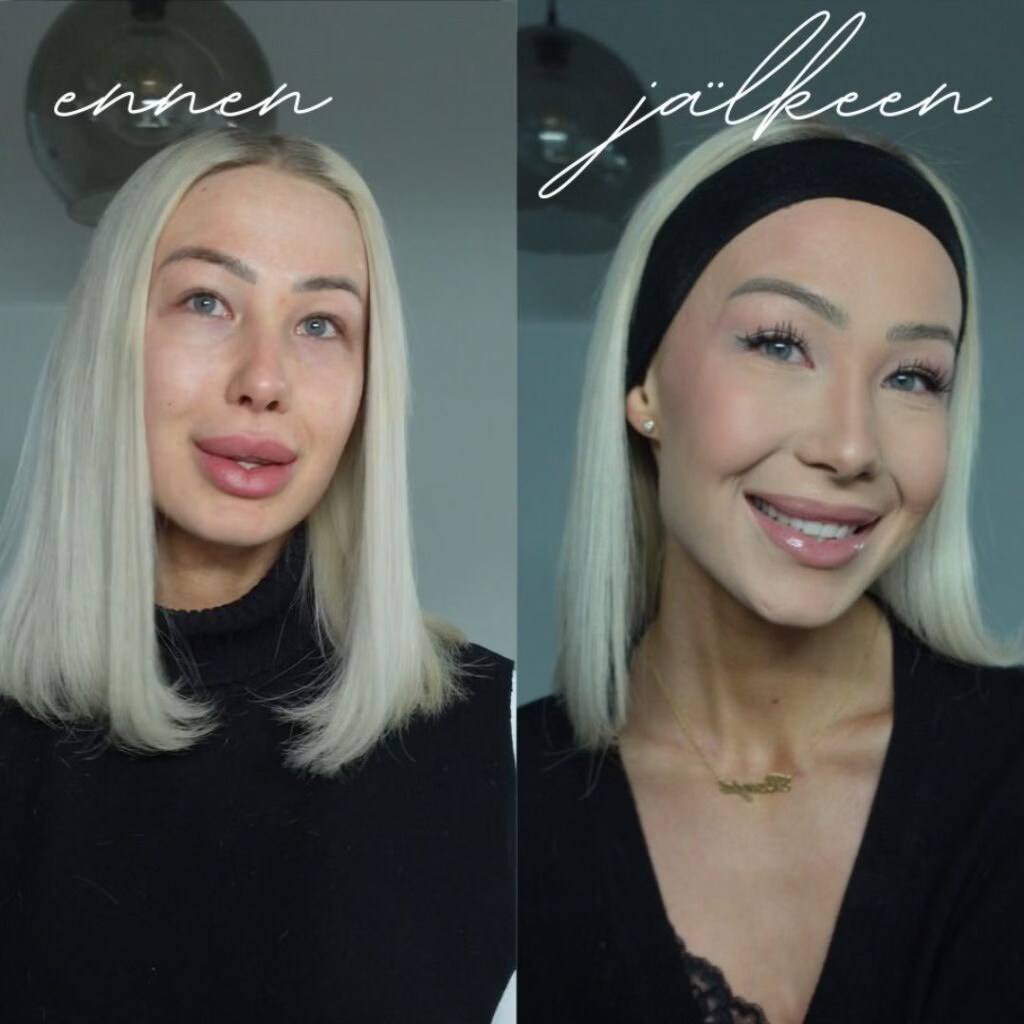
Did you know that?
- Hyaluronidase breaks down only hyaluronic acid, not the skin's own collagen or other compounds.
- Hyaluronidase also breaks down the skin’s own hyaluronic acid. This phenomenon is feared unnecessarily. The skin’s own hyaluronic acid is replenished within 24–72 hours. As for the skin’s own hyaluronic acid, the situation is therefore quickly resolved, within four weeks at the latest.
- Dissolving the filler does not cause the face to sag. If your features feel hollow after removal, this is because the filler had previously masked the natural signs of aging.
- According to scientific studies, the effects of hyaluronidase become apparent within the first 48 hours, but Laura’s clinical experience shows that tissue recovery and the appearance of the final results take two to four weeks.
Therefore, I recommend that any new filler treatment be performed only one month after the removal of the fillers, once the tissue has fully recovered from the hyaluronidase treatment.
– Laura Juopperi
- Sometimes the filler has settled deep beneath the skin or migrated over a larger area than expected. In these cases, it may take more than one treatment session to achieve the final result.
- When correcting a botched lip filler procedure, it is likely that the filler that has spread to the mucous membranes will not be completely removed even after two or three treatments.
A failed filler treatment is always corrected calmly and carefully. I never use more than the standard dose of hyaluronidase just to be safe. I perform the treatment in a so-called conservative manner: I’d rather use too little than too much at once. If necessary, I increase the amount of the substance in a controlled manner during a follow-up visit. This ensures a natural and beautiful end result.
– Laura Juopperi
Side effects, risks, and complications
These are common, temporary reactions associated with the use of hyaluronidase:
- Swelling and redness: common during the first few days, usually mild and temporary.
- Bruising: Bruises may appear at the injection sites, but they will go away on their own within a few days.
- Tenderness or itching: You may experience mild tenderness or itching at the treatment site.
- Temporary asymmetry: swelling or uneven dissolution of the filler may cause temporary asymmetry.
Correcting a failed dermal filler treatment with hyaluronidase is a safe procedure. However, there are some risks associated with the procedure.
- Allergic reaction: Rare, but possible. That is why Laura performs an allergy test before treatment, if necessary.
- Overdose: Excessive use of hyaluronidase may dry out the skin.
- Incomplete dissolution of the filler: In some cases, the filler does not dissolve completely after a single treatment session. Additional treatments always entail additional costs.
Although hyaluronidase is generally a well-tolerated drug, it is important to remember that it can, in rare cases, cause an allergic reaction.
Reactions may occur immediately after the injection or may be delayed. Symptoms range from mild redness, itching, and local swelling to more serious reactions, such as widespread hives or respiratory symptoms.
I carefully assess each patient's condition before treatment and, if necessary, perform a small allergy test on the arm. This ensures that the treatment is as safe as possible.
– Dr. Laura Juopperi
Frequently Asked Questions
Is it possible to remove the filler from just a small area?
It is common to want to remove only a small portion of the filler—for example, hyaluronic acid that has migrated outside the red area of the lips. This is often possible.
However, it is important to remember that hyaluronidase always spreads over an area of a couple of square centimeters. A very precisely defined removal from a very small area is not possible, Laura explains.
Does the removal of fillers ever occur?
Correcting a failed filler treatment is generally painless. If the correction is performed on the lips, the lips can be numbed before the procedure using what is known as a “dental anesthetic.” Without anesthesia, the injection site usually feels like a slight pinch or pressure. Actual pain is fairly rare.
When can I exercise?
Laura advises her clients to avoid intense exercise for the first 24 hours. You can engage in light physical activity, such as walking, on the same day.
How soon can I go back to work?
You can return to work right away if you feel well. Sometimes there may be swelling or bruising in the area, which could be a social barrier, for example, in customer service work. The swelling usually goes down within a couple of days.
How much does the procedure cost?
at VM Aesthetics hyaluronidase ampoule costs 350 euros. If two ampoules are needed during the same visit, the total cost is 450 euros. The amount required depends on the volume, type, and location of the filler to be removed.
How quickly does hyaluronidase take effect?
Hyaluronidase begins to break down the hyaluronic acid-based filler rapidly. The most significant changes may be visible within the first 48 hours, but the final result is generally not assessed until two weeks after the procedure.
Will the filler material definitely be removed completely?
In most cases, a large portion of the hyaluronic acid filler can be removed with hyaluronidase. Sometimes small amounts of the filler may remain in the tissues. In such cases, the treatment can be repeated.
Can a new filler treatment be performed on the area where the filler was removed?
Yes, it is possible. A new filler treatment can usually be performed once the treated area has fully healed and the final result has been evaluated. The appropriate timing will be determined on an individual basis during your appointment. As a general rule, there should be at least two weeks—and preferably four—between the removal and the new filler treatment.
What does a failed filler treatment mean?
Filler treatment is considered a failure if the results are unsatisfactory, the features become asymmetrical or look unnatural, or the filler shifts to the wrong location.
Can hyaluronidase also break down the body's own hyaluronic acid?
Yes. Hyaluronidase also temporarily breaks down the body’s own hyaluronic acid. However, the body constantly produces more of it, so the effect is usually temporary.
My filler treatment didn't go well—what should I do?
If your dermal filler treatment hasn't gone as planned and you want to find out whether having the filler removed is the right solution for you, book an appointment for a free, no-obligation consultation with Dr. Laura Juopperi.
